Friday, January 14, 2011

Via dei Fori Imperiali, Rome

Il Vittoriano
Via dei Fori Imperiali – это широкая улица в центре Рима от Пьяцца Венеция и мемориала Витториано к Колизею. Она проходит поверх раскопок форумов Траяна и Августа. На этой улице и вокруг неё сосредоточено такое большое количество достопримечательностей, что трудно решить, с каких начать?
Площадь Венеции расположилась недалеко от Форума у подножия Капитолия. Здесь находится бывшее представительство Венецианской республики в папском Риме – дворец Венеции и церковь святого Марка.

С площади открывается вид на мемориал Витториано. Церковь св. Марка была построена в 336 году в честь апостола Марка и перестроена в 828—844 годах. Апсида церкви украшена мозаикой IX века, изображающей Христа в окружении апостолов и святых, а также папы Григория IV с квадратным нимбом. В руках папа держит макет церкви.
Витториано (Il Vittoriano) — монумент в честь первого короля объединённой Италии Виктора Эммануила II. В Витториано располагаются два музея: борьбы за политическое объединение Италии и знамён военного флота. Монумент характеризуется чрезмерной эклектикой и нагромождением различных деталей, характерных для древнеримских сооружений (колонны, барельефы, статуи и др.). По мнению многих, памятник выделяется среди прочих римских зданий, поэтому среди римлян распространены различные снисходительно-презрительные наименования данного монумента: «Пишущая машинка» («Macchina da Scrivere»), «Свадебный торт».

Римский форум
Римский форум служил центром общественной жизни в Древнем Риме, и из повседневного общения людей эволюционировало тематическое общение, носящее все признаки того, что мы сегодня называем форумом. Он располагается в долине между тремя римскими холмами – Палатин, Капитолий и Эксквилин. Сейчас это место руин.
Любители древности, несомненно, получат огромное удовольствие побродить по развалинам Древнего Рима – здесь есть остатки разных периодов (царского, республиканского и имперского). Нам больше всего понравились колонны храма Сатурна, триумфальные арки Септимия Севера и Константина, а также колона Траяна.

В этом же районе расположен, наверное, самый известный символ Рима – Колизей. Колизей - самый большой из древнеримских амфитеатров и одно из самых примечательных сооружений в мире. Он первоначально назывался Амфитеатром Флавиев, потому что был коллективным сооружением императоров династии Флавиев. Строительство велось на протяжении 8 лет, в 72-80 гг. н. э.
Колизей
Колизей оставляет двойственное чувство. С одной стороны он страшен, так как долгое время был для жителей Рима и приезжих главным местом увеселительных зрелищ, таких, как бои гладиаторов, звериные травли или инсценировки, в ходе которых девушки и женщины насиловались быками, ослами и другими домашними животными и дикими зверями. С другой стороны, он является символом Рима. И как его не любить, если ты любишь Рим?
Колизей утратил две трети своей первоначальной массы; тем не менее, она и поныне беспримерно громадна: один архитектор в XVIII приблизительно вычислил количество заключающегося в Колизее строительного материала, и определил его стоимость, по ценам того времени, в 1½ миллиона скудо – это коллосальная сумма! Поэтому Колизей издревле считался символом величия Рима. «Пока Колизей стоит» — говорили пилигримы в VIII столетии — «будет стоять и Рим, исчезни Колизей — исчезнут Рим и вместе с ним весь мир».

Friday, December 24, 2010

Musei Vaticani


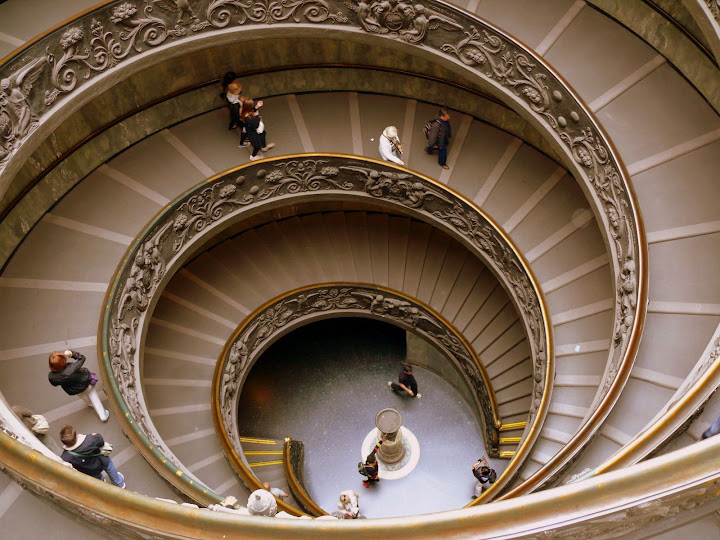
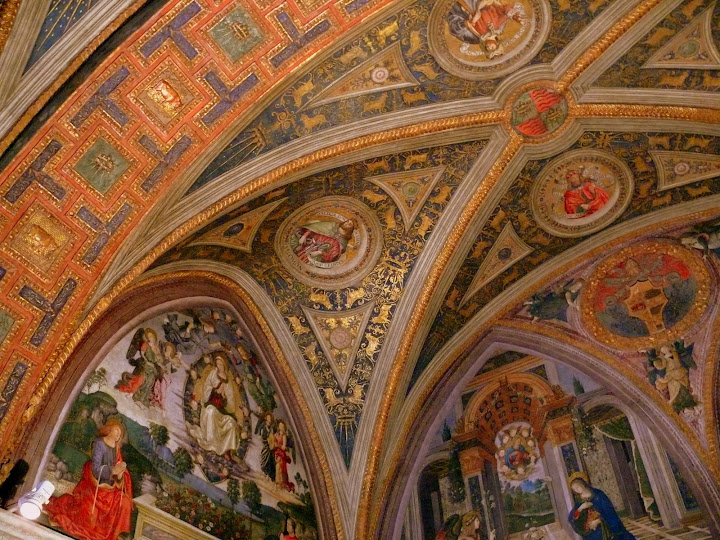
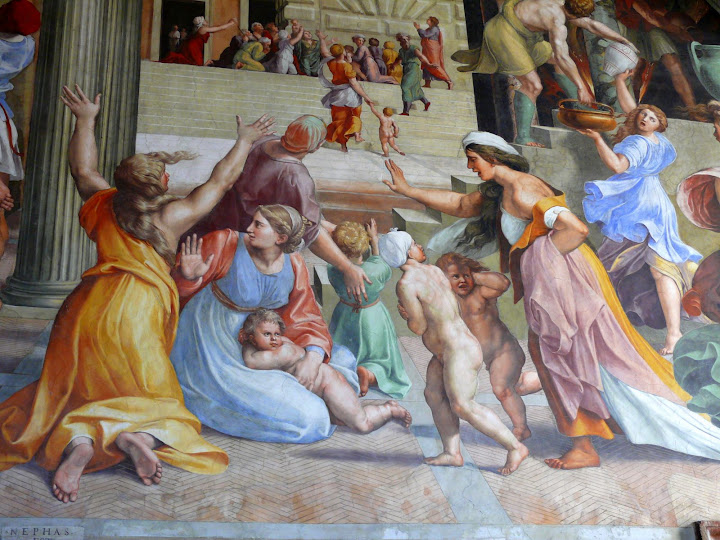
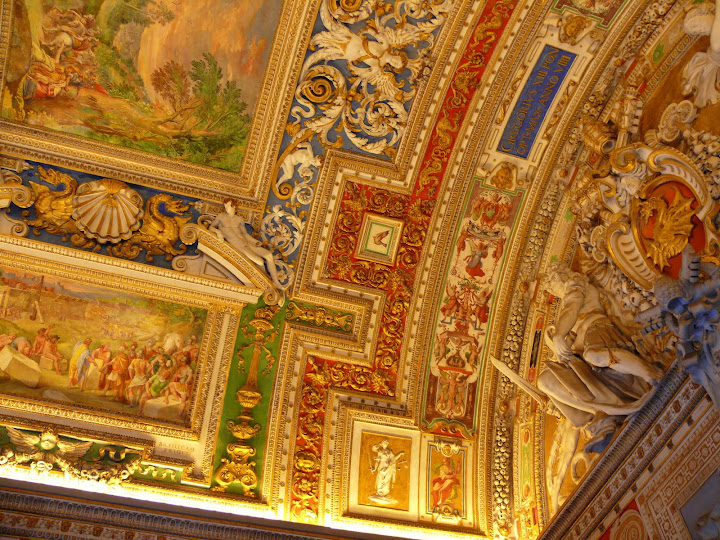
Музеи Ватикана – крупнейшие музеи мира, включающие комплекс уникальных зданий и ценнейших коллекций, которые оставляют одно из самых интересных и неповторимых ощущений в Риме. К ним относятся следующие музеи:


  • Станцы Рафаэля - комнаты в папском дворце, расписанные Рафаэлем
  • Капелла Никколина. Личная капелла папы Николая V, расписанная Фра Анджелико.
  • Апартаменты Борджиа. Личные апартаменты Александра VI, расписанные в том числе Пинтуриккьо, сейчас находится часть коллекции современного религиозного искусства

  • Сикстинская капелла - выдающийся памятник Возрождения.
  • Ватиканская пинакотека в Бельведерском дворце. Представлена византийская и европейская живопись XI—XIX вв.
  • Ватиканская библиотека. Самое значительное собрание древних рукописей в мире.
  • Грегорианский египетский музей. Располагается собрание предметов египетского искусства из Рима и окрестностей.
  • Грегорианский этрусский музей. Выставлены предметы быта этрусков, древнегреческие сосуды из некрополей этрусков.
  • Музей Пио-Клементино. Основан с целью хранения известных греческих и римских произведений искусства (скульптура, мозаика)
  • Музей Кьярамонти посвящен античной скульптуре
  • Галерея гобеленов
  • Галерея географических карт
  • Галерея канделябров
  • Лоджии Рафаэля
  • Коллекция современного церковного искусства
  • Грегорианский музей светского искусства


Сикстинская Капелла
Никто не покинет Рима, не увезя с собой какого-нибудь воспоминания о Микеланджело: будь это собор Святого Петра или необыкновенная красота Сикстинской капеллы.
Сикстинская Капелла – одно из самых известных сокровищ Ватикана. Она создавалась 14 лет, и в 2008 году праздновала свое 500-летие. Название капелле дал Папа Сикст IV, который нанял архитектора Джованни де Дольчи для ее строительства по эскизам традиционных романских базилик. Мировую же славу шедевр приобрел благодаря Микеланджело, который украсил своды фресками.
В 1505 году папа заказал роспись Микеланджело. Тот поначалу отказывался, объясняя свое нежелание тем, что он не живописец, а скульптор, и предлагая поручить эту работу Рафаэлю. Однако понтифик настоял, чтобы именно Микеланджело занялся росписью капеллы. Нехотя он приступил к работе. Вызвал из Флоренции помощников и начал подготовку к созданию фрески. Качество первого проекта росписи полностью отвечало чувствам мастера по отношению к этому заказу. Он был более чем скромен. Микеланджело планировал написать лишь фигуры 12 апостолов. Но неожиданно для всех (и для самого себя в первую очередь) проект полностью захватила его. Он заперся в капелле в полном одиночестве и лежа на спине на строительных лесах расписывал свод. Фрески свода изображают эпизоды священной истории, зафиксированные в книге Бытия, – от сотворения мира до потопа. Таким образом он создал одно из величайших произведений искусства.
Микеланджело вернулся в капеллу спустя двадцать лет, чтобы по заказу папы Павла III выполнить фреску, изображающую Страшный суд. Когда через пять лет художник продемонстрировал готовую работу, понтифик в восхищении пал на колени.
Фреска поражает монументальностью и размахом. На ней запечатлено около 400 фигур в разнообразных, ни разу не повторяющихся позах. Благодаря мастерству художника, каждая фигура кажется трехмерной, словно она не написана, а изваяна.

Рассмотреть этот шедевр можно здесь.

Thursday, December 23, 2010

Базилика Святого Петра

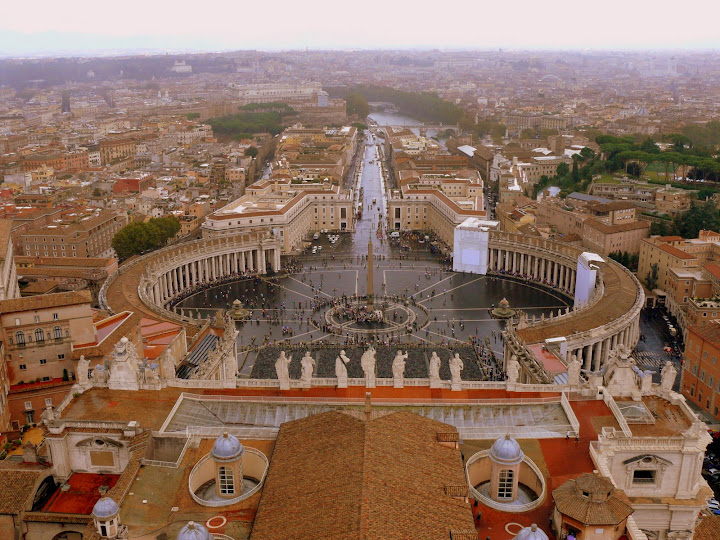
Утром около 9 часов пошли смотреть музеи Ватикана, но из-за очень длинной очереди изменили план и решили начать знакомство с Ватиканом с Базилики Святого Петра. Сначала мы пришли на грандиозную площадь перед собором. Здесь собираются толпы верующих, чтобы слушать выступления понтифика. Площадь обрамляют спроектированные Бернини полукруглые колоннады тосканского ордера. Посередине — египетский обелиск, привезённый в Рим императором Калигулой. Это единственный обелиск в городе, который простоял в неизменном виде вплоть до Возрождения. Средневековые римляне полагали, что в металлическом шаре на вершине обелиска хранится прах Юлия Цезаря. От обелиска по брусчатке расходятся лучи из травертина, устроенные так, чтобы обелиск выполнял роль гномона. Когда-то на том месте, где теперь стоит собор св. Петра, располагались сады цирка Нерона (от него, кстати, остался обелиск из Гелиополя, который до сего дня стоит на площади Св. Петра). Первая базилика была построена в 324 г., в правление первого христианского императора Константина. Алтарь собора был размещен над могилой, со второго века считаемой захоронением св. Петра, принявшего в 66 г. мученическую кончину в цирке Нерона.
Внутри собор поражает и гармонией пропорций, и своими огромными размерами, и богатством оформления — здесь масса статуй, алтарей, надгробий, множество замечательных произведений искусства. Общая длина базилики 211,6 м. На полу центрального нефа имеются отметки, показывающие размеры других крупнейших соборов мира, что позволяет сравнить их с самым громадным, собором св. Петра.
В подкупольном пространстве над главным алтарём находится шедевр Бернини — огромный, высотой 29 м балдахин (киворий) на четырёх витых колоннах, на которых стоят статуи ангелов. Бронзу для кивория взяли из Пантеона, разобрав по приказу папы Урбана VIII конструкции, которые поддерживали крышу портика. Сквозь балдахин видна находящаяся в центральной апсиде и также созданная Бернини кафедра св. Петра. Она включает поддерживаемое четырьмя статуями отцов церкви кресло св. Петра, над которым парит в сиянии символ Святого Духа. Справа от кафедры — надгробие папы Урбана VIII работы Бернини, слева — надгробие Павла III (XVI в.) работы Гульельмо делла Порта, одного из учеников Микеланджело.
В первой капелле правого нефа справа находится шедевр Микеланджело — мраморная «Пьета». Она была создана им на рубеже XV и XVI столетий в возрасте 23 лет. После того как злоумышленником была совершена попытка разбить статую, её защитили стеклом.
Мы прогулялись по собору, поприсутствовали на воскресной литургии, а после этого решили посетить знаменитый купол этого собора.

Купол собора Св. Петра
Купол собора Св. Петра — венец архитектурного творчества Микеланджело. Микеланджело не удалось полностью воплотить этот замысел, он успел при жизни построить тамбур огромного (42 м в диаметре) купола, возведенного после его смерти Джакомо делла Порта, несколько удлинившим его пропорции. Работая над громадным куполом, венчающим собор Св. Петра. Микеланджело учитывал опыт сооружения купола флорентийского собора Санта Мария дель Фьоре, возведенного Филиппо Брунеллески, по поводу которого он сказал: «Повторять тебя не хочу, лучше сделать не умею». И тем не менее он нашел свое решение. Микеланджело же стремится превзойти Брунеллески и создать такой купол, чтобы под ним могли укрыться все христианские народы. Не повторяя купола Брунеллески, Микеланджело сумел дать свою еще более внушительную концепцию. Если Брунеллески возводил купол флорентийского собора на восьмигранном барабане, сохранив в нем соответствующие восемь ребер, то Микеланджело дал куполу собора Св. Петра шестнадцатигранное основание, по существу, приближенное к кругу. Барабан купола декорирован мощными спаренными колоннами и нишами между ними. Громадный, цельный, торжественный купол собора Св. Петра и теперь господствует над Римом, утверждая мощь дарования его создателя. В этом архитектурном творении Микеланджело в убедительных формах выразил свое ренессансное представление о величии и грандиозных возможностях человека, веру в которые он пронес даже в эти труднейшие годы своей жизни. Купол собора Св. Петра стал символом власти, а также моделью для куполов в западно-европейской и даже американской архитектуре - достаточно сравнить его с куполом Капитолия в Вашингтоне.
Для того чтобы подняться на купол необходимо преодолеть порядка 500 ступенек, но оно того стоит. Непосредственно на купол ведет длинная узкая лестница, расположенная между внешним и внутренним куполом; примерное представление о ней можно получить из фильма «Dolce Vita» («Сладкая жизнь»), сюда герой Марчелло Мастрояни приводил актрису со свитой. С купола открывается потрясающий вид не только на Ватикан, но и на весь Рим. Я думаю, что здесь самаю лучшая панорама города.

Ватиканские гроты
После посещения купола мы решили не останавливаться и, после небольшого перерыва на обед, посетить Ватиканские гроты - нижний уровень собора, где находятся гробницы некоторых пап, а также могила св. Петра. Здесь же находится гробница предпоследнего понтифика Иоанна Павла II, тут всегда свежие цветы и много людей вокруг. Кроме того, в гротах можно посмотреть на саркофаги пап, нескольких иностранных государей и на остатки мраморов и мозаики из древней константиновой базилики. И, конечно, главное – место исповедания святого Петра – Confessio – богато отделанная мрамором капелла, находящаяся над гробницей апостола (капелла отгорожена стеклом).
Посещение собора и гротов бесплатное, а купол - 7 евро.

Wednesday, July 28, 2010

combinatoricslib: compositions

A composition of an integer n is a way of writing n as the sum of a sequence of (strictly) positive integers. Two sequences that differ in the order of their terms define different compositions of their sum, while they are considered to define the same partition of that number.
The sixteen compositions of 5 are:
1.5
2.4+1
3.3+2
4.3+1+1
5.2+3
6.2+2+1
7.2+1+2
8.2+1+1+1
9.1+4
10.1+3+1
11.1+2+2
12.1+2+1+1
13.1+1+3
14.1+1+2+1
15.1+1+1+2
16.1+1+1+1+1.


Example. Generate compositions of 5.

// create composition generator of 5
Generator<integer> compositionGenerator = new CompositionGenerator(5);

// create iterator
Iterator<combinatoricsvector<Integer>> compositionIterator = compositionGenerator.createIterator();

// go through the iterator
while (compositionIterator.hasNext()) {
CombinatoricsVector<integer> composition = compositionIterator.next();
System.out.println(partitionIterator);
}

And the result

CompositionIterator=[#1, CombinatoricsVector=[[5]], size=1]]
CompositionIterator=[#2, CombinatoricsVector=[[1, 4]], size=2]]
CompositionIterator=[#3, CombinatoricsVector=[[2, 3]], size=2]]
CompositionIterator=[#4, CombinatoricsVector=[[1, 1, 3]], size=3]]
CompositionIterator=[#5, CombinatoricsVector=[[3, 2]], size=2]]
CompositionIterator=[#6, CombinatoricsVector=[[1, 2, 2]], size=3]]
CompositionIterator=[#7, CombinatoricsVector=[[2, 1, 2]], size=3]]
CompositionIterator=[#8, CombinatoricsVector=[[1, 1, 1, 2]], size=4]]
CompositionIterator=[#9, CombinatoricsVector=[[4, 1]], size=2]]
CompositionIterator=[#10, CombinatoricsVector=[[1, 3, 1]], size=3]]
CompositionIterator=[#11, CombinatoricsVector=[[2, 2, 1]], size=3]]
CompositionIterator=[#12, CombinatoricsVector=[[1, 1, 2, 1]], size=4]]
CompositionIterator=[#13, CombinatoricsVector=[[3, 1, 1]], size=3]]
CompositionIterator=[#14, CombinatoricsVector=[[1, 2, 1, 1]], size=4]]
CompositionIterator=[#15, CombinatoricsVector=[[2, 1, 1, 1]], size=4]]
CompositionIterator=[#16, CombinatoricsVector=[[1, 1, 1, 1, 1]], size=5]]

Please, read more here.

Tuesday, February 2, 2010

Combinatoricslib: generating partitions

In number theory, a partition of a positive integer n is a way of writing n as a sum of positive integers. Two sums that differ only in the order of their summands are considered to be the same partition; if order matters then the sum becomes a composition. A summand in a partition is also called a part.

The partitions of 5 are listed below:
1 + 1 + 1 + 1 + 1
2 + 1 + 1 + 1
2 + 2 + 1
3 + 1 + 1
3 + 2
4 + 1
5

The number of partitions of n is given by the partition function p(n). In number theory, the partition function p(n) represents the number of possible partitions of a natural number n, which is to say the number of distinct (and order independent) ways of representing n as a sum of natural numbers.

This is a code:

// create partition generator of 5
Generator<Integer> partitionGenerator = new PartitionGenerator(5);

// create iterator
Iterator<CombinatoricsVector<Integer>> partitionIterator = partitionGenerator.createIterator();

partitionIterator.first();

// go through the iterator
while (!partitionIterator.isDone()) {
partitionIterator.next();
CombinatoricsVector<Integer> partition = partitionIterator.getCurrentItem();
System.out.println(partitionIterator);
}


And the result


PartitionIterator=[#1, CombinatoricsVector=[[1, 1, 1, 1, 1]], size=5]]
PartitionIterator=[#2, CombinatoricsVector=[[2, 1, 1, 1]], size=4]]
PartitionIterator=[#3, CombinatoricsVector=[[2, 2, 1]], size=3]]
PartitionIterator=[#4, CombinatoricsVector=[[3, 1, 1]], size=3]]
PartitionIterator=[#5, CombinatoricsVector=[[3, 2]], size=2]]
PartitionIterator=[#6, CombinatoricsVector=[[4, 1]], size=2]]
PartitionIterator=[#7, CombinatoricsVector=[[5]], size=1]]


Please read more here http://code.google.com/p/combinatoricslib/

Thursday, January 28, 2010

combinatoricslib: permutations with repetitions

The permutation may have more elements than slots. For example, the three possible permutation of 12 in three slots are: 111, 211, 121, 221, 112, 212, 122, and 222.

Please read more here http://code.google.com/p/combinatoricslib/


This is a code:


// create array of initial items
ArrayList<String> array = new ArrayList<String>();
array.add("one");
array.add("two");

// create combinatorics vector
CombinatoricsVector<String> corePermutation = new CombinatoricsVector<String>(array);

// create permutation with repetition generator, second parameter is a number of slots
Generator<String> permutationWithRepetitionGenerator = new PermutationWithRepetitionGenerator<String>(corePermutation, 3);

// create iterator
Iterator<CombinatoricsVector<String>> permutationWithRepetitionIterator = permutationWithRepetitionGenerator.createIterator();

// print the number of generated permutations
System.out.println("Number of permutationWithRepetition is: " + permutationWithRepetitionGenerator.getNumberOfGeneratedObjects());
permutationWithRepetitionIterator.first();

// go through the iterator
while (!permutationWithRepetitionIterator.isDone()) {
permutationWithRepetitionIterator.next();
CombinatoricsVector<String> permutationWithRepetition = permutationWithRepetitionIterator.getCurrentItem();
System.out.println(permutationWithRepetitionIterator);
}

And the result

Number of permutationWithRepetition is: 8
PermutationWithRepetitionIterator=[#1, CombinatoricsVector=[[one, one, one]],size=3]]
PermutationWithRepetitionIterator=[#2, CombinatoricsVector=[[two, one, one]],size=3]]
PermutationWithRepetitionIterator=[#3, CombinatoricsVector=[[one, two, one]],size=3]]
PermutationWithRepetitionIterator=[#4, CombinatoricsVector=[[two, two, one]],size=3]]
PermutationWithRepetitionIterator=[#5, CombinatoricsVector=[[one, one, two]],size=3]]
PermutationWithRepetitionIterator=[#6, CombinatoricsVector=[[two, one, two]],size=3]]
PermutationWithRepetitionIterator=[#7, CombinatoricsVector=[[one, two, two]],size=3]]
PermutationWithRepetitionIterator=[#8, CombinatoricsVector=[[two, two, two]],size=3]]

Tuesday, January 26, 2010

combinatoricslib: permutations without repetitions

I would like to introduce combinatoricslib. This is a library written on Java that contains various stuff to resolve different issues connected to combinatorics such as generating combinatorial objects and etc.

Today I am presenting permutations without repetitions. A permutation is an ordering of a set in the context of all possible orderings. For example, the set containing the first three digits, 123, has six permutations: 123, 132, 213, 231, 312, and 321.

This is a example of permutation of 3 string items: 

// create array of initial items
ArrayList<string> array = new ArrayList<string>();
array.add("one");
array.add("two");
array.add("three");

// create combinatorics vector
CombinatoricsVector<string> corePermutation = new CombinatoricsVector<string>(array);

// create permutation generator
Generator<string> generator = new PermutationGenerator<string>(corePermutation);

// print the number of generated permutations
System.out.println("Number of permutations is: " + gnerator.getNumberOfGeneratedObjects());

// create iterator
Iterator<combinatoricsvector<string>> iterator = generator.createIterator();
iterator.first();

// go through the iterator
while (!iterator.isDone()) {
iterator.next();
CombinatoricsVector<string> permutation = iterator.getCurrentItem();
System.out.println(permutation);
}


Output result is

Number of permutations is: 6
CombinatoricsVector=[[one, two, three]], size=3]
CombinatoricsVector=[[one, three, two]], size=3]
CombinatoricsVector=[[three, one, two]], size=3]
CombinatoricsVector=[[three, two, one]], size=3]
CombinatoricsVector=[[two, three, one]], size=3]
CombinatoricsVector=[[two, one, three]], size=3]

You can read more and download the library from here  

Thursday, June 4, 2009

Sofiyivsky Park in Uman named after a beautiful woman


Uman is a city located in the Cherkasy Oblast (province) in central Ukraine, to the east of Vinnytsia. Uman is known since 1616 as a defensive fort built against Tatar raids and a prominent Cossack regiment was stationed in the town. In 1670–1674, Uman was a residence of the Hetman of right-bank Ukraine.
In 1793 Uman became part of the Russian Empire and a number of aristocratic residences were built there. Uman's landmark is a famous park complex Sofiyivka (Софiївка; Polish: Zofiówka) founded in 1796 by Count Stanisław Szczęsny Potocki, a noble Polish szlachcic, who named it for his wife Sofia.
A good park is designed in such a way that it creates for people experiences that uplift their spirits, expand their vision, and invigorate their lives. In this respect parks are a form of art. Garden and landscape design is also a science that is directly related to and expressive of nature insofar as it incorporates natural materials and scenes. Art and science fully manifest themselves in the Sofiyivka Park where art, science, and nature are most intimately interlocked.
In some very special way, the beauty of the park reflects the beauty of the woman who gave the park its name.


The husband, smitten with Sophie’s beauty and perspicacity, reacted dutifully and issued an order to have a park laid out. He commissioned Ludwig Metzel, an architect, to provide a design and supervise the work. Metzel travelled around Europe, looking at parks and purchasing equipment and machinery needed for laying out a park that “would outshine any other park in Europe.”
Similar to some other famous parks of the time — Versailles, the Belvedere Park in Vienna, the Vatican Gardens in Rome, Hellbrun in Salzburg, Blenheim in England, Drottningsholm in Sweden and Peterhof (Petrodvorets) in Russia — Sofiyivka was largely planned in the Italian Baroque tradition with themes from the myths of the Greco-Roman antiquity in full display. Sofiyivka has its own Elysian Fields, its own River Styx; statues and busts of Socrates, Plato, Aristotle, Apollo, Mercury and Venus grace the alleys and groves. The new, “English style” ideas in landscaping were also used with “wild sections” added in good measure.

When most of the work had been completed, Sophie was invited to visit “a very special gift” given her by her husband — an entire park of unparalleled beauty. Though it was mid-summer the whimsical woman wanted to ride into the park in a sledge — or so a popular story, maybe apocryphal, goes — and the central alley was covered with a thick layer of salt. A poet in her entourage wrote a poem eulogizing the park and the woman after whom the park was named (the word Sofiyivka is derived from Sophie, of course). The poem was translated into French and published with engravings done by a gifted artist and master engraver. The book was appreciated in high society and both the park and Sophie were the topic of conversation in many salons across Europe.
Count Potocki died in 1805 without seeing the park being completed in the way he visualized it. Neither were all of the plans of his architect Metzel realized. Potocki’s children either did not care to have all the work the park completed according to the original design or did not have money for it. After an insurrection in Poland, in which Alexander Potocki, one of the count’s sons, took part, was brutally suppressed by the tsarist army, the park was confiscated to become property of Nicholas I who gave it as a present to his wife. The name was officially changed to The Tsar’s Park but locally it continued to be referred to as “Sofiyivka.” The local authority took the maintenance on itself and in 1848, the 84-year old Metzel was invited to come over from Warsaw where he resided to Uman to complete the work in the park. But the aged architect never made it to Sofiyivka — he was taken ill on the way to Uman and shortly died.


Sophie Potocka is a very colourful figure that deserves a book to be written about her. It is not easy now, two centuries after she bewitched and charmed so many men, among them Prince Grigory Potemkin, the famous favourite of the Russian Empress Catherine II and statesman in his own right, to separate fact from fiction. Even if in what we shall relate here not everything is proven fact, most of the story is well established, if slightly embellished, is true, thanks to reliable evidence that has been dug up in the archives by historians and made available to the public.
Sophie was born in a Greek village on the outskirts of Constantinople, “the city of the world’s desire.” Her widowed mother traded vegetables to support her children, Sophie and her sister. When she was approached with a proposal to sell her daughter she did not turn the ignoble proposition down — she accepted gladly as it improved considerably her financial situation. Sophie was sold to the Polish Ambassador who must have spotted the girl at the market, and who procured girls for King Stanislas-Augustus (incidentally, Sophie’s fine sister was sold to the harem of a senior Ottoman pasha, and became his “chief wife”).
From then on, every time she was sold and bought, another man fell in love with her and outbid the first. On her way to Poland with the ambassadorial baggage, Sophie de Tchelitche, as she then called herself, was spotted by Major de Witte, son of the governor of the fortress of Kamyanets-Podilsky (then under Polish domination). He was completely smitten by her beauty and talked the ambassador into selling the girl to him for a thousand gold ducats. But Sophie refused to become a concubine — she agreed to share de Witte’s bed only if he married her. And he did. Sophie was fourteen when she became the major’s wife (much to the annoyance of de Witte’s father, who was said to have been won over by her charm the moment he saw her). Witte sent Sophie to Paris with Princess Nassau-Siegen to learn manners. She learnt French too.
She was nicknamed the “Beautiful Greek,” “La Belle Phanariotte,” after the Greek Phanar district. La Belle Phanariotte bewitched Paris. Comte Alexander de Langeron praised “the tenderness and most beautiful eyes that nature had ever formed,” but he was under no illusion about her cunning manipulations and the “coldness of heart.” Some of her fascination was “a sort of originality proceeding from either naivety or ignorance.” Everybody praised her “beaux yeaux” (beautiful eyes).
Back in Poland, her husband, now himself governor of Kamyanets, was the linchpin of Prince Potemkin’s espionage network, and it was probably Sophie who provided some valuable information. Sophie became the mistress of General Nikolay Saltykov, and was spotted and introduced to Potemkin in Ochakov. She “flung herself around” to impress the Prince and he was impressed. She supplanted Princess Dolgorukaya as Potemkin’s mistress who appointed the complaisant husband to be governor of Kherson. It is likely Sophie was used as a secret agent among the Poles and Turks.
he Empress was informed of Sophie’s services to help the Russian cause and gave the “Beautiful Greek” a pair of diamond earrings. This made Sophie’s husband so proud that he boasted she would be remembered in history as the friend of royalty.
Potemkin soon lost interest in “this Oriental, this intriguer, this Venus,” but Sophie de Witte did not lose interest in further promotion. She was spotted by Felix Potocki who fell madly in love with her.
Stanislaw Szczesny Potocki (born either in 1751 or 1752) was a Polish statesman and general of great prominence during the breakup of the elective Kingdom of Poland. The son of Franciszek Salezy Potocki, palatine of Kyiv, of the Tulczyn line of the Potocki family, he entered public service in 1774, became lieutenant general and then general of artillery. Though considered a liberal aristocrat, he identified the public welfare with the welfare of the magnates and thus opposed every project for reform in the Diet, or Parliament. Unsuccessful in his obstructionism, he went first to Vienna and then to St. Petersburg, where, with the connivance of the Empress Catherine, he formed the Confederation of Targowica for the maintenance of the ancient institutions of Poland in 1792, of which he was the marshal, or dictator, directing its operations from his castle at Tulczyn. When the liberal May Constitution in Poland was overthrown and the Prussians were already in occupation of Great Poland, Potocki went on a diplomatic mission to St. Petersburg in March 1793, but, finding himself duped and set aside, retired to Vienna.
Sophie hooked Potocki, “the richest kinglet” of Poland, in Jassy, after Potemkin’s death. Potocki was married and had children, and Sophie was still married to de Witte. Potocki was so overwhelmed with love for the Beautiful Greek that he agreed to pay hundreds of thousands of gold ducats to de Witte to get his consent for divorce. His own wife who stubbornly refused to divorce Potocki, confidently died and the Pole was free at last to marry Sophie. He brought her to Uman to show her one of his estates and it was there and then that she admired the scenery so much that her husband was inspired to have a park laid out to be given to her as a gift.
It was not a happy marriage. Sophie embarked on a passionately tempestuous affair with her stepson twenty-two year old Yuri Potocki, “committing all the crimes of Sodom and Gomorrah.” When once Felix Potocki inadvertently surprised them on a sofa, in each other’s arms, he was so shocked that left for Tulczyn in a hurry never to return to Uman, and died there in 1805.
Sophie told one of the visitors, a person who had known her since Potemkin’s days, “You know what I am and whence I come, eh bien, I cannot live with just 60,000 ducats of revenue.”

And she did not. The Russian Emperor Alexander I himself was known to help her get what she wanted in legal battles over Potocki’s heritage with Potocki’s children from the first marriage.
She drove the serfs in the estates that belonged to her so hard that there were several disturbances in the villages that belonged to her, and in the police actions to quell them many peasants were wounded and killed.
Four years after her husband died, Sophie threw out the son and showing a great skill of entrepreneurship and business acumen, built up a fortune to raise her own seven children.
Countess Potocka died at the age of 58, “honoured and admired,” in 1822.
The park is still there, to be visited and thoroughly enjoyed.

Wednesday, May 20, 2009

Pereiaslav-Khmelnytskyi (Переяслав Хмельницкий)

Pereiaslav-Khmelnytskyi. Переяслав-Хмельницкий. Музей народной архитектуры. Схема

Pereiaslav-Khmelnytskyi played a significant role in the history of Ukraine. It was mentioned for the first time in the text of the Rus' treaty with the Byzantine Empire (911) as Pereyaslav-Russki.

Among its well-known museums are: Museum of Bread (63), Museum of Land Transportation (65), Museum of Ukrainian Decorative Towels (16), Museum of Sholem Aleichem (62) (Solomon Rabinowitz, a nineteenth-century Yiddish humorist), Museum of Space Exploration (45), Museum of Postal Services (66), Museum of Beekeeping, Museum of Applied and Decorative Arts (38), Museum of Ukrainian Traditional Rituals (42), Museum of Archeology, Museum of the Cossack Glory, Museum of Trypillya Culture, Museum of Ukrainian Traditional Dress, etc.

Музей народної архітектури та побуту Середньої Наддніпрянщини.

  1. Хата перших комунарів
  2. Водяний млин
  3. Садиба бідняка, 19 ст.
  4. Кузня
  5. Садиба ткача
  6. Вітряки
  7. Садиба теслі
  8. Садиба гребінника
  9. Садиба бондаря
  10. Шишкосушарня


  11. Музей лікарских рослин
  12. Лісовий кордон, 19 ст.
  13. Корчма
  14. Садиба заможного селянина
  15. Водяний млин
  16. Церква трьох святителів, 1745 р. Музей українського рушника
  17. Садиба заможного селянина
  18. Церква Святого Георгія, 1768 р.
  19. Гамазей
  20. Гончарна піч
  21. Садиба гончара
  22. Поліська хата
  23. Шинок, 19 ст.


  24. Садиба середняка
  25. Садиба пасічника. Музей исторії бджільництва
  26. Хата знахарки
  27. Садиба чинбаря
  28. Сільска управа
  29. Гойдалки
  30. Колодязь журавель
  31. Садиба олійника
  32. Хата безземельного селянина
  33. Селянська садиба. Віставка народно-ужиткового мистецтва
  34. Садиба вдови, 19 ст.
  35. Капличка 19 ст.
  36. Панський будинок 19ст. Меморіальний музей М.М.Бернардоса
  37. Ротонда
  38. Панський будинок 19 ст. Музей декоративно-ужиткового мистецтва
  39. Музей історії української православної церкви
  40. Селянська садиба
  41. Церковно-парафіяльна школа 19 ст.
  42. Музей україньких народних обрядів і звичаїв
  43. Будинок священника
  44. Дзвіниця 18 ст.
  45. Музей космосу, церква 1833 р.
  46. Церква Святого Іоанна 1606 р.
  47. Колодязьні зруби 17 ст.
  48. Сільске житло черняхівскої культури 4 ст. (реконструкція)
  49. Садиба киянина 10 ст. (реконструкція)
  50. Житло черняхівської культури (реконструкція)
  51. Пізньополовецьке святилише 7-8 ст. (реконструкція)
  52. Залишки житлово-господарського комплексу 10 ст з Києва
  53. Добраничівська стоянка пізнього палеоліту (реконструкція)
  54. Камьяні баби
  55. Степові кургани 3-2 ст. до н.е. (памьятки найдавнішої монументальної архітектури на території України)
  56. Камьяні баби
  57. Житло 14 ст. з Києва (реконструкція)
  58. Гончарна піч 10 ст. (реконструкція)
  59. Житло 11 ст. з Переяслава (реконструкція)
  60. Половецьке святилище
  61. Камьяна скульптура та поховальні скрині
  62. Музей класика еврейскої літератури Шолом-Алейхема
  63. Музей хліба
  64. Хата хлібороба 19 ст.
  65. Музей сухопутного транспорту
  66. Музей почти, почтова станція міста Переяслав 19 ст.
  67. Козацький постій (реконструкція)
  68. Музей памьяті Поліського району Київської області
  69. Мисливський будинок князя Костянтина Горчакова