What is your favorite film of the Bond series? I would say the sixth 007 film "On Her Majestry's Secret Service" (1969) would be the best Bond film if only Sean Connery had played Bond. Well, I like the film because of the following things. To me, James Bond belongs to 1960s. So the films of that period of time are more natural for my impression. The second thing that I like in the film is the locations in Switzerland - the amazing hotel/restaurant on the top of Mount Schilthorn that became Blofeld's clinic and base. This post is about that place. Finally, the third thing is that OHMSS has the most unique ending of any other Bond film.:)
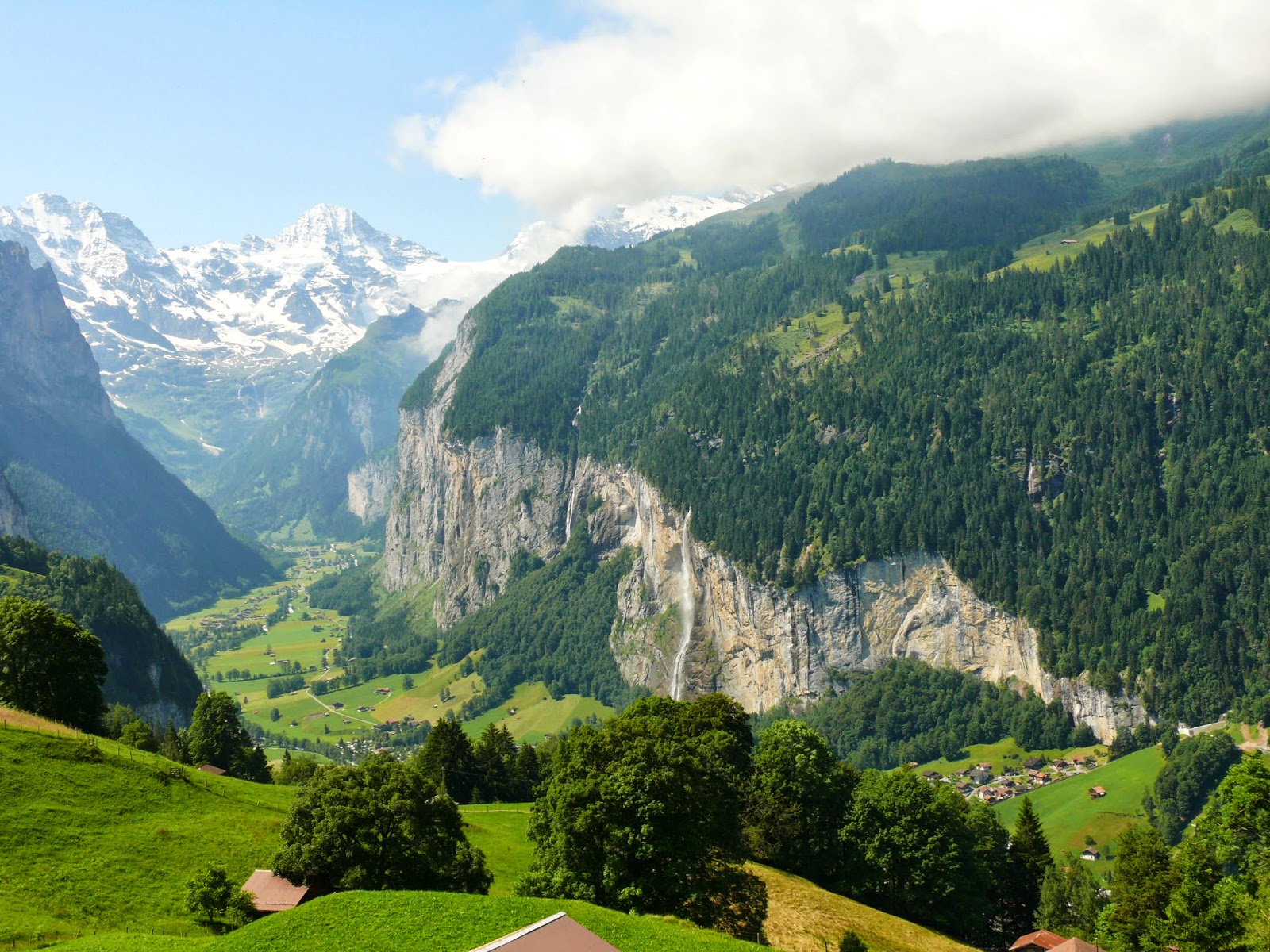
We were staying in Interlaken. This is a beautiful small town in the Bernese Oberland in Switzerland.So our route started from there to Lauterbrunnen Valley and the cable car from Lauterbrunnen to Grütschalp and a train to Murren, from where the cable car was taken. Between Birg and the summit, the cable car passes over Grauseeli, a small lake.
Not only the view all around from up at the summit worth a million dollars, the journey up there is exhilarating as well. The views from the train and cable cars can just steal your breath away. Just do remember to breathe!
We were lucky with a beautiful clear day. The three giant famous peaks Jungfrau, Monch and Eiger were looked so nice and so near. Here is the revolving restaurant Piz Gloria where you can sit for a full meal or just a drink, a lovely souvenir shop and Bond World! So you can feel yourself almost like Bond among the places he visited in Dr. Blofeld's clinic.
The panoramic view spans from the Titlis, Jungfrau, Monch, Eiger, over the Bernese Alps and the Jura mountains up to the Vosges Mountains and the Black Forest. Be prepared to take lots of shots. However, this is entirely subjected to cloud conditions. The summit is usually enshrouded by a lot of clouds. :(
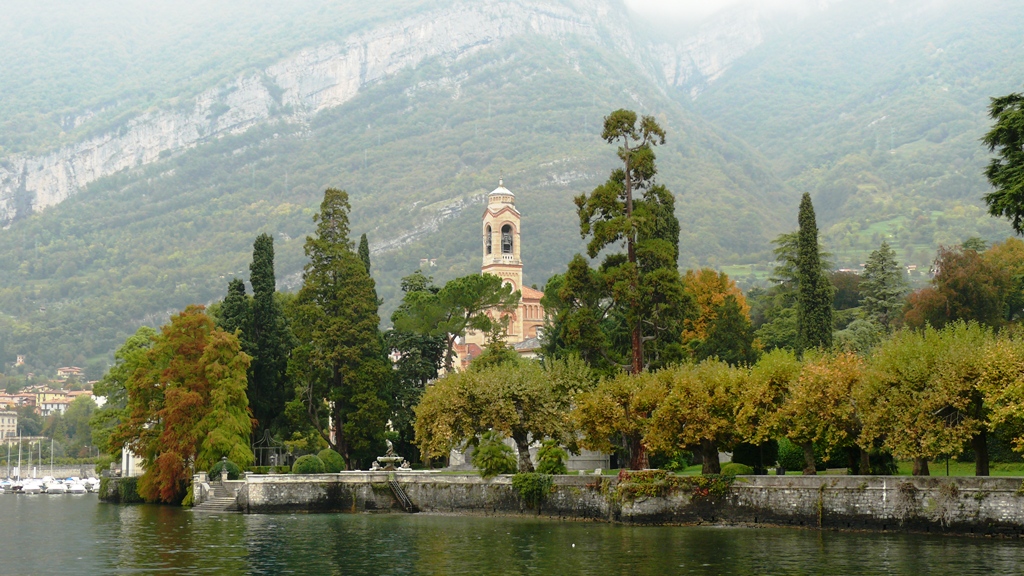
If you are a follower of 'Star Wars' series and would like to see how Naboo looks then you definitely should visit Italy. There is a very beautiful Villa del Balbianello in Lenno which overlooks Lake Como. The villa was shown in the episode II 'Attack of Clones' (2002) as Varykino, also known as the Lake Retreat, where Padmé Amidala and Anakin Skywalker hid while Obi-Wan Kenobi tracked down those responsible for attempting to assassinate Amidala and where the clandestine marriage of Skywalker and Amidala took place.
When I saw the episode I noticed that the name "Varykino" was a name from Boris Pasternak's novel "Doctor Zhivago". It is a place where doctor Yuri Zhivago and Lara are hiding from arrest. I remembered the movie Dr Zhivago (1965) with Omar Sharif and Geraldine Chaplin not only because of Varykino, but also because of Alec Guinness. He was Obi Wan Kenobi in Star Wars and Yevraf in Dr Zhivago.
Varykino (Dr. Zhivago)
It has been suggested that Anakin (Darth Vader) was modeled off of the Pavel Strelnikov character in Dr Zhivago - a young idealist who later becomes a merciless military leader in the Galactic Empire (Soviet Government). The destruction of Alderaan in A New Hope presumably mirroring Strelnikov's destruction of a Siberian village suspected of being loyal to the White Army in Zhivago. Interestingly, both characters also "die" - Anakin in the lava pit in Revenge of the Sith, and Strelnikov during World War I in Zhivago - before being "reborn" as a more evil character.
Varykino (Star Wars)
The villa was featured not only in Star Wars, but in 'Casino Royale' in 2009.
All the areas used in the films are accessible to the public.You can take a train from Milano Centrale to Varenna-Esino and then take a boat to Lenno via Bellagio and Tremezzo.
You can walk to the Villa from Lenno, I’d suggest getting a boat either there or back as you get a wonderful view from the water as the boat passes alongside the promontory. The Villa and the surrounding grounds are beautiful and the view across the lake is absolutely breathtaking. The atmosphere is very peaceful and relaxed and you are able to explore the grounds and the building at your own leisure.
You can visit a balcony, where the two heroes kiss for the first time although Padmé later pulls away as their love is forbidden. In the final scene, when Anakin and Padmé get married in secret, they return to the balcony.
I like this place and strongly recommend it for visiting.
In the day of Easter officiating the 26th of April 1478 in the main cathedral of Florence a certain Francesco Pazzi and his friends tried to slaughter the town’s governors Lorenzo and his brother Giuliano Medici. This episode has entered into the history as the “Pazzi Conspiracy”.
Where did the famous family Medici appear from? And how that happened that they were governing Florence for centuries and supplying the beauties to the leading royal families of Europe? The French queens Catherine Medici and Maria Medici are the most famous for us, but there were a lot of other queens and princesses of Medici in Europe.
They were hereditary pharmacists. Once upon a time a good fortune met an offspring of Medici, a son of a poor widow, Giovanni. His cousin gave him a position in one of the banks in Rome. Giovanni discovered his talent there. The forefather of the future royal generation reached a bank governor. He went into politics and start sponsoring the known corsair Baldassare Cossa which had a claim on Papal throne. The corsair became an antipope (John XXIII) in 1410 and recompensed his creditor assigning the Medici’s bank to control the finance of the Roman Catholic Church.
Giovanni Medici was considered as a “God’s banker” and he started developing an international financial network. He opened branches in Lion and London. That was easy to him because all non-payers were excommunicated from the Church. Growing rich the founder of the Medici bank family took a great interest in art and became a Maecenas. His son Cosimo was the heir to the bank empire. Cosimo grew as a very educated person. Banking was not enough to him and he went into politics in real. He sustained a defeat in the beginning. He was accused of a conspiracy and nearly executed. But he turned out well suborning the watches. He got even with his prosecutor later on.
The political system in Florence could be considered as an oligarchic democracy. The power was elective and belonged to deputies of Signoria. But in fact the power belonged to several family clans. The head of the clan was the first among equals. He didn’t have any titles and usually didn’t occupy any official positions just being considered as a national leader. Coup d'état meant a change of the ruling clan. Parties had simple and understandable names, for example, the party of the Albizzi family (predecessors of Medici). The underlying task of a candidate was to throw off the leader. Do not allow that was the main task for the leader. Having the intention of getting power in Florence, Cosimo gained the popularity of Florence’s people. He had got power with the peak of people’s admiration to him. By the way, Brunelleschi got a row and funding for the construction of the couple of the cathedral under the pressure of Cosimo Medici.
The Founder of the Medici dynasty is called Cosimo the Elder. The dynasty of old Casimo was not good enough in the beginning. The eldest son died very young, the youngest son was an unhealthy and a poet. Which leader could be from a poet? Therefore old Cosimo loved very much his grandson Lorenzo. He was promised to be a real leader. And that really happened. Lorenzo the Magnificent (how he was called by the time) ruled the Florence until 1492. Leonardo Da Vinci, Sandro Botticelli and Michelangelo Buonarroti were supported by Lorenzo. Michelangelo spent his boyhood in the Lorenzo’s house together with the Lorenzo’s children. Lorenzo shared the power in Florence with his younger brother Giuliano until the attempt on their life happened on the 26th of April. The conspiracy against the Medici was not something unusual at that time. Of cause, Medici had a lot of enemies and their counter-intelligence worked quit well. Sometimes the conspiracies were discovered by Lorenzo himself. For example, once he successfully prevented an attempt on his father’s life. Though, the “Pazzi Conspiracy” was not noticed by the Medici brothers.
Who were those Pazzi? Their family was much more honorable than the chemist family of Medici. A crusader Pazzi was the first who climbed over the town’s wall during the siege of Jerusalem in 1099. He got three stones from the Church of the Holy Sepulcher. The head of the Pazzi family stroked the holy fire from these stones each Ester in Florence. People lighted candles during the religious procession to the baptistery. Dante Alighieri immortalized the Pazzi family in his Divine Comedy. The emblem of Pazzi was hanged all over Florence. Their palace was the most luxurious in Florence; Pazzi had a claim on the most important positions of the city.
They had a bank and a trading company. Pazzi started their business at the same time as Cosimo Medici but not in Rome, in Barcelona.
At the time of conspiracy the head of the Pazzi financial empire was Jacopo Pazzi. He didn’t have his own sons, but had a lot of nephews, among which the most courageous was a certain young man by the name Francesco. A bad idea had entered into his head: Medici of humble origin had power in Florence while Pazzi of noble birth had to be satisfied with the second role - cold hands and hot heart were founded for the conspiracy. What about a head? Where was the head of the conspiracy?
The head was in the Basilica of Saint Peter in Rome. The Pope Sixt IV took an offence at Medici. Medici’s bank refused lending 40 thousand ducats for the Holy Throne of. Pope had wanted to make a present to his nephew. Medici refused the request because the founder Giovanni had said that money shouldn’t be given to authorities without any benefits. It appears that Pope Sixt IV was a very rancorous. He took away the status of the “God’s bank” from Medici bank and gave it to Pazzi. In response Medici took away Pazzi from the power in Florence.
Francesco Pazzi lived in Rome, where he started spinning the conspiracy. The archbishop of Pisa took active participation in the conspiracy. He expected to move to Florence in case of success. Conspirators enlisted external’s support and gathered large forces with the help of Pope Sixt IV. Jacopo Pazzi was informed about the conspiracy. He was against it in the beginning, but when he made sure that the conspiracy can’t be stopped at that point he started supporting the idea. Conspirators found some young dissatisfied people in Florence, which were core of the fighting squads.
Initially it was supposed to entice Lorenzo from Florence to Rome and dealt shortly with him there and to kill Giuliano in Florence. But Lorenzo was not going to go to Rome. Then a cardinal, an envoy of Pope came to Florence and the official reception was appointed on 28th of April in the Pazzi’s villa. The Medici brothers were supposed to be poisoned on that ceremony. But Giuliano had fallen ill, and became known that he would not visit the ceremony. Delay was not impossible because a lot of people knew about the conspiracy, and all of them could be arrested. The murder was scheduled for Easter. The priest, who conducted the divine service in the cathedral, was aware of the murder. He had to kill Lorenzo. Francesco agreed to kill Giuliano Medici by himself. The archbishop of Pisa, Jacopo Pazzi and others should occupy the Signoria and declare the power change.
So the divine service started in the cathedral. Lorenzo came; he had to come because the envoy of Pope was there. Giuliano was absent, he was ill. Then Francesco Pazzi went to the Medici’s Palace. Facetious saying he persuaded Giuliano to go to the cathedral. He even helped him to go supporting his shoulder. They were chatting with each other in a friendly manner during the way to the church.
When they entered to the Basilica Francesco started drew a dagger and plunge it into Giuliano. He was killing Giuliano with incredible fury so that the dagger hurt his own leg. There were 19 dagger wounds counted on the Giuliano’s body. At the same time the conspirators attacked Lorenzo Medici and hurt his neck. Lorenzo was hidden in a crowd closer to the altar. The crowed defended him. The killers tried to escape, but they were caught and killed by their own weapons. The attack was repulsed; Lorenzo took refuge in a sacristy. The cardinal instigator hid in another sacristy.
At that time the archbishop of Pisa and his friends being absolutely sure of success of their venture went into the Signoria. There was a night and all deputies went away basically, but somebody stayed there. And the second fatal misfortune overtook the conspirators here. The door of the chancellery can be opened by the key only. The conspirators burst into the chancellery destroying all on their way. Somehow the heavy door has slammed behind them and all fighting squad turned out in a trap.
The archbishop of Pisa and some other men started arresting the speaker (the gonfaloniere), but they were slightly unconvincing in their behavior. The gonfaloniere suspected that something is wrong and threw out of his office. Everybody who was in the building of the Signoria resorted to the help of him. The conspirators were unable to wrestle with the people because they were lost the fighting squad which was blocked in the chancellery. All conspirators were caught, tied up and threw out of the Palazzo Vecchio’s windows.
Some Francesco’s troops should have come to the aid of them, but Francesco was bleeding from a self-inflicted wound. The old Jacopo Pazzi wasn’t able to such kind of feat of arms and he hesitated in his choice too long than it was possible. When finally he ventured to go, saddled up a horse and arrived to the Signoria’s square as a head of an armed hundred, he saw the conspirators had just been hanged and a crowd of people hurling stones to him and his soldiers. Confused Jacopo Pazzi decided to save his life of the crowd and to leave of troops from the town. He expected to take cover in his own villa, but he was caught and disarmed on his way to home.
Waves of riots were spread across the town. The townspeople took advantage of the moment. Houses of Pazzi were looted down. Francesco was caught and hanged naked in the same window, where the Archbishop of Pisa had been already hung. All of the Pazzi were caught in three days and everybody was hung. Only one survived, which was married to a Lorenzo’s sister. Some time ago Cosimo Medici married his granddaughter to one of the Pazzi wishing to reconcile two families. No reconciliation was availed, but the life of one man was saved. He was stripped of his status and banished from Florence forever. All distant relatives of the Pazzi family did three years in prison.
The corpse of Jacopo Pazzi was buried initially, but then it was dug up and thrown into the River Arno.
Niccolo Machiavelli wrote: "This is truly the clearest example of the vicissitudes of fate, when a man from the heights of wealth and prosperity was so ignominiously overthrown into the abyss of the greatest misfortunes."
The “Pazzi Conspiracy” was ramified and went far beyond Florence. The famous portrait of the Duke of Urbino, the pride of the Uffizi Gallery, represents one of the conspirators also. Despite the fact that the duchy Urbino was very far from Florence, a letter of the Duke to Pope Sixt IV has been found recently, where the duke promised to give an army of 600 men to restore order after the Medici overthrow in Florence.
Paintings depicting at least some of the Pazzi no longer exist. Their portraits were thoroughly destroyed, so that even the memory of this family is not survived. All of their palaces and houses were destroyed as well (except their main house). The Pazzi Chapel (designed by Brunelleschi in the complex of Basilica of Santa Croce) survived by accident. But there are no things which belonged to the Pazzi family.
Lorenzo made a sumptuous funeral of his killed brother. Several months later, his illegitimate son was born, which was also named Giuliano. He'll be brought up in Lorenzo's house like his own son together with Lorenzo’s children. Many years later, this child will become Pope Clement VII.
Nowadays the Pazzi family name has revealed oneself in a completely unexpected context. A psychological thriller “Hannibal” is a sequel to the famous film "The Silence of the Lambs" was released in 2001. It left nobody indifferent. One of the strongest moments of the film, which links it with Florence, is the story of how Hannibal Lector rips the belly of Rinaldo Pazzi a policeman and hangs his twitching corpse famously from the window of the Palazzo Vecchio (that white window that under the clock). Probably Francesco Pazzi was being hung from the same window.
In the film Rinaldo Pazzi is a direct descendant of Francesco, who repeated his fate after exactly 500+ years. Dr. Lector is mocking Rinaldo Pazzi all the time in the movie, alluding to his relationship with the hanging man 5 hundred years ago. Rinaldo is confused on that and says that this story is forgotten already. "Hannibal" was being filmed for 16 weeks in Florence. An idea of shooting such kind of movie did not cause a clear delight among the Florence people. There were protest demonstrations and the film crew was strongly interfered. But the authorities of Florence allowed shooting hoping, perhaps, to a certain advertisement of Florence. However, there is no Florence in the movie. Even the Palazzo Vecchio and Piazza della Signoria are not look like a beautiful place for civilized people.
Uman is a city located in the Cherkasy Oblast (province) in central Ukraine, to the east of Vinnytsia. Uman is known since 1616 as a defensive fort built against Tatar raids and a prominent Cossack regiment was stationed in the town. In 1670–1674, Uman was a residence of the Hetman of right-bank Ukraine. In 1793 Uman became part of the Russian Empire and a number of aristocratic residences were built there. Uman's landmark is a famous park complex Sofiyivka (Софiївка; Polish: Zofiówka) founded in 1796 by Count Stanisław Szczęsny Potocki, a noble Polish szlachcic, who named it for his wife Sofia. A good park is designed in such a way that it creates for people experiences that uplift their spirits, expand their vision, and invigorate their lives. In this respect parks are a form of art. Garden and landscape design is also a science that is directly related to and expressive of nature insofar as it incorporates natural materials and scenes. Art and science fully manifest themselves in the Sofiyivka Park where art, science, and nature are most intimately interlocked. In some very special way, the beauty of the park reflects the beauty of the woman who gave the park its name.
The husband, smitten with Sophie’s beauty and perspicacity, reacted dutifully and issued an order to have a park laid out. He commissioned Ludwig Metzel, an architect, to provide a design and supervise the work. Metzel travelled around Europe, looking at parks and purchasing equipment and machinery needed for laying out a park that “would outshine any other park in Europe.”
Similar to some other famous parks of the time — Versailles, the Belvedere Park in Vienna, the Vatican Gardens in Rome, Hellbrun in Salzburg, Blenheim in England, Drottningsholm in Sweden and Peterhof (Petrodvorets) in Russia — Sofiyivka was largely planned in the Italian Baroque tradition with themes from the myths of the Greco-Roman antiquity in full display. Sofiyivka has its own Elysian Fields, its own River Styx; statues and busts of Socrates, Plato, Aristotle, Apollo, Mercury and Venus grace the alleys and groves. The new, “English style” ideas in landscaping were also used with “wild sections” added in good measure. When most of the work had been completed, Sophie was invited to visit “a very special gift” given her by her husband — an entire park of unparalleled beauty. Though it was mid-summer the whimsical woman wanted to ride into the park in a sledge — or so a popular story, maybe apocryphal, goes — and the central alley was covered with a thick layer of salt. A poet in her entourage wrote a poem eulogizing the park and the woman after whom the park was named (the word Sofiyivka is derived from Sophie, of course). The poem was translated into French and published with engravings done by a gifted artist and master engraver. The book was appreciated in high society and both the park and Sophie were the topic of conversation in many salons across Europe. Count Potocki died in 1805 without seeing the park being completed in the way he visualized it. Neither were all of the plans of his architect Metzel realized. Potocki’s children either did not care to have all the work the park completed according to the original design or did not have money for it. After an insurrection in Poland, in which Alexander Potocki, one of the count’s sons, took part, was brutally suppressed by the tsarist army, the park was confiscated to become property of Nicholas I who gave it as a present to his wife. The name was officially changed to The Tsar’s Park but locally it continued to be referred to as “Sofiyivka.” The local authority took the maintenance on itself and in 1848, the 84-year old Metzel was invited to come over from Warsaw where he resided to Uman to complete the work in the park. But the aged architect never made it to Sofiyivka — he was taken ill on the way to Uman and shortly died.
Sophie Potocka is a very colourful figure that deserves a book to be written about her. It is not easy now, two centuries after she bewitched and charmed so many men, among them Prince Grigory Potemkin, the famous favourite of the Russian Empress Catherine II and statesman in his own right, to separate fact from fiction. Even if in what we shall relate here not everything is proven fact, most of the story is well established, if slightly embellished, is true, thanks to reliable evidence that has been dug up in the archives by historians and made available to the public.
Sophie was born in a Greek village on the outskirts of Constantinople, “the city of the world’s desire.” Her widowed mother traded vegetables to support her children, Sophie and her sister. When she was approached with a proposal to sell her daughter she did not turn the ignoble proposition down — she accepted gladly as it improved considerably her financial situation. Sophie was sold to the Polish Ambassador who must have spotted the girl at the market, and who procured girls for King Stanislas-Augustus (incidentally, Sophie’s fine sister was sold to the harem of a senior Ottoman pasha, and became his “chief wife”). From then on, every time she was sold and bought, another man fell in love with her and outbid the first. On her way to Poland with the ambassadorial baggage, Sophie de Tchelitche, as she then called herself, was spotted by Major de Witte, son of the governor of the fortress of Kamyanets-Podilsky (then under Polish domination). He was completely smitten by her beauty and talked the ambassador into selling the girl to him for a thousand gold ducats. But Sophie refused to become a concubine — she agreed to share de Witte’s bed only if he married her. And he did. Sophie was fourteen when she became the major’s wife (much to the annoyance of de Witte’s father, who was said to have been won over by her charm the moment he saw her). Witte sent Sophie to Paris with Princess Nassau-Siegen to learn manners. She learnt French too. She was nicknamed the “Beautiful Greek,” “La Belle Phanariotte,” after the Greek Phanar district. La Belle Phanariotte bewitched Paris. Comte Alexander de Langeron praised “the tenderness and most beautiful eyes that nature had ever formed,” but he was under no illusion about her cunning manipulations and the “coldness of heart.” Some of her fascination was “a sort of originality proceeding from either naivety or ignorance.” Everybody praised her “beaux yeaux” (beautiful eyes). Back in Poland, her husband, now himself governor of Kamyanets, was the linchpin of Prince Potemkin’s espionage network, and it was probably Sophie who provided some valuable information. Sophie became the mistress of General Nikolay Saltykov, and was spotted and introduced to Potemkin in Ochakov. She “flung herself around” to impress the Prince and he was impressed. She supplanted Princess Dolgorukaya as Potemkin’s mistress who appointed the complaisant husband to be governor of Kherson. It is likely Sophie was used as a secret agent among the Poles and Turks. he Empress was informed of Sophie’s services to help the Russian cause and gave the “Beautiful Greek” a pair of diamond earrings. This made Sophie’s husband so proud that he boasted she would be remembered in history as the friend of royalty. Potemkin soon lost interest in “this Oriental, this intriguer, this Venus,” but Sophie de Witte did not lose interest in further promotion. She was spotted by Felix Potocki who fell madly in love with her. Stanislaw Szczesny Potocki (born either in 1751 or 1752) was a Polish statesman and general of great prominence during the breakup of the elective Kingdom of Poland. The son of Franciszek Salezy Potocki, palatine of Kyiv, of the Tulczyn line of the Potocki family, he entered public service in 1774, became lieutenant general and then general of artillery. Though considered a liberal aristocrat, he identified the public welfare with the welfare of the magnates and thus opposed every project for reform in the Diet, or Parliament. Unsuccessful in his obstructionism, he went first to Vienna and then to St. Petersburg, where, with the connivance of the Empress Catherine, he formed the Confederation of Targowica for the maintenance of the ancient institutions of Poland in 1792, of which he was the marshal, or dictator, directing its operations from his castle at Tulczyn. When the liberal May Constitution in Poland was overthrown and the Prussians were already in occupation of Great Poland, Potocki went on a diplomatic mission to St. Petersburg in March 1793, but, finding himself duped and set aside, retired to Vienna. Sophie hooked Potocki, “the richest kinglet” of Poland, in Jassy, after Potemkin’s death. Potocki was married and had children, and Sophie was still married to de Witte. Potocki was so overwhelmed with love for the Beautiful Greek that he agreed to pay hundreds of thousands of gold ducats to de Witte to get his consent for divorce. His own wife who stubbornly refused to divorce Potocki, confidently died and the Pole was free at last to marry Sophie. He brought her to Uman to show her one of his estates and it was there and then that she admired the scenery so much that her husband was inspired to have a park laid out to be given to her as a gift. It was not a happy marriage. Sophie embarked on a passionately tempestuous affair with her stepson twenty-two year old Yuri Potocki, “committing all the crimes of Sodom and Gomorrah.” When once Felix Potocki inadvertently surprised them on a sofa, in each other’s arms, he was so shocked that left for Tulczyn in a hurry never to return to Uman, and died there in 1805. Sophie told one of the visitors, a person who had known her since Potemkin’s days, “You know what I am and whence I come, eh bien, I cannot live with just 60,000 ducats of revenue.” And she did not. The Russian Emperor Alexander I himself was known to help her get what she wanted in legal battles over Potocki’s heritage with Potocki’s children from the first marriage. She drove the serfs in the estates that belonged to her so hard that there were several disturbances in the villages that belonged to her, and in the police actions to quell them many peasants were wounded and killed. Four years after her husband died, Sophie threw out the son and showing a great skill of entrepreneurship and business acumen, built up a fortune to raise her own seven children. Countess Potocka died at the age of 58, “honoured and admired,” in 1822. The park is still there, to be visited and thoroughly enjoyed.
Pereiaslav-Khmelnytskyi played a significant role in the history of Ukraine. It was mentioned for the first time in the text of the Rus' treaty with the Byzantine Empire (911) as Pereyaslav-Russki.
Among its well-known museums are: Museum of Bread (63), Museum of Land Transportation (65), Museum of Ukrainian Decorative Towels (16), Museum of Sholem Aleichem (62) (Solomon Rabinowitz, a nineteenth-century Yiddish humorist), Museum of Space Exploration (45), Museum of Postal Services (66), Museum of Beekeeping, Museum of Applied and Decorative Arts (38), Museum of Ukrainian Traditional Rituals (42), Museum of Archeology, Museum of the Cossack Glory, Museum of Trypillya Culture, Museum of Ukrainian Traditional Dress, etc.
Музей народної архітектури та побуту Середньої Наддніпрянщини.
Хата перших комунарів
Водяний млин
Садиба бідняка, 19 ст.
Кузня
Садиба ткача
Вітряки
Садиба теслі
Садиба гребінника
Садиба бондаря
Шишкосушарня
Музей лікарских рослин
Лісовий кордон, 19 ст.
Корчма
Садиба заможного селянина
Водяний млин
Церква трьох святителів, 1745 р. Музей українського рушника
Садиба заможного селянина
Церква Святого Георгія, 1768 р.
Гамазей
Гончарна піч
Садиба гончара
Поліська хата
Шинок, 19 ст.
Садиба середняка
Садиба пасічника. Музей исторії бджільництва
Хата знахарки
Садиба чинбаря
Сільска управа
Гойдалки
Колодязь журавель
Садиба олійника
Хата безземельного селянина
Селянська садиба. Віставка народно-ужиткового мистецтва
Садиба вдови, 19 ст.
Капличка 19 ст.
Панський будинок 19ст. Меморіальний музей М.М.Бернардоса
Ротонда
Панський будинок 19 ст. Музей декоративно-ужиткового мистецтва
Музей історії української православної церкви
Селянська садиба
Церковно-парафіяльна школа 19 ст.
Музей україньких народних обрядів і звичаїв
Будинок священника
Дзвіниця 18 ст.
Музей космосу, церква 1833 р.
Церква Святого Іоанна 1606 р.
Колодязьні зруби 17 ст.
Сільске житло черняхівскої культури 4 ст. (реконструкція)
Садиба киянина 10 ст. (реконструкція)
Житло черняхівської культури (реконструкція)
Пізньополовецьке святилише 7-8 ст. (реконструкція)
Залишки житлово-господарського комплексу 10 ст з Києва
Добраничівська стоянка пізнього палеоліту (реконструкція)
Камьяні баби
Степові кургани 3-2 ст. до н.е. (памьятки найдавнішої монументальної архітектури на території України)
Камьяні баби
Житло 14 ст. з Києва (реконструкція)
Гончарна піч 10 ст. (реконструкція)
Житло 11 ст. з Переяслава (реконструкція)
Половецьке святилище
Камьяна скульптура та поховальні скрині
Музей класика еврейскої літератури Шолом-Алейхема
Музей хліба
Хата хлібороба 19 ст.
Музей сухопутного транспорту
Музей почти, почтова станція міста Переяслав 19 ст.
Grenen, the northmost tip of Jutland, north of the town of Skagen, thereby the northmost point of Denmark. Grenen was given its name for its shape like a tree-branch (Danish: gren).
The headland at Grenen is a spectacular setting where the two Seas meet, the North-Sea meets the Baltic-Sea. This makes for turbulent seas and strandings— beachings and shipwreckings are not uncommon. The frequent shipping losses and the strategic location as the gateway to the Baltic led to Skagen being the site of one of Denmark's earliest lighthouses, constructed in the 15th century. A reconstruction of the lighthouse is located to the north of the town of Skagen.
The City of Gothenburg was founded in 1621 by the King Gustavus Adolphus of Sweden. It is situated at the mouth of Göta Älv, the river running through the city and is the largest sea port of the Nordic countries. Gothenburg is also a significant university city with a large student population of both the University of Gothenburg, which is Scandinavia's largest university and Chalmers University of Technology. Gothenburg is located on the west coast, in Southwestern Sweden, approximately half way between the capitals Copenhagen, Denmark, and Oslo, Norway.
There are very few houses left from the 17th century when the city was founded, since all but the military and royal houses were built of wood.
The first major architecturally interesting period is the 18th century when the East India Company made Gothenburg an important trade city. Imposing stone houses with a Classical look were erected around the canals. One example from this period is the East India House, which today houses Gothenburg’s City Museum.
Gothenburg has a rich music life - the Gothenburg Symphony Orchestra is the best known when it comes to classical music. Gothenburg also was the birthplace of the Swedish composer Kurt Atterberg. Bands like The Soundtrack of Our Lives and Ace of Base are well known pop representatives of the city.
Due to the Gothenburg's advantageous location in the centre of Scandinavia, trade and shipping have always played a major role in the city's economic history, and they continue to do so. Gothenburg port has come to be the largest harbour in the whole of Scandinavia.
Apart from trade, the second pillar of Gothenburg has traditionally been manufacturing, and industry which significantly contributes to the city's wealth. Major companies operating plants in the area include SKF, Volvo and Ericsson. Volvo Cars is the largest employer in Gothenburg, not including jobs in supply companies. The blue collar industries which have dominated the city for long are still important factors in the city's economy, but they are being gradually replaced by high tech industries.
Hamburg is the second-largest city in Germany (after Berlin) and along with its central port, also the second-largest port in Europe (after Rotterdam) and the most populous city in the European Union which is not a national capital. The city is home to approximately 1.8 million Hamburgers. Hamburg is located on the southern point of the Jutland Peninsula, directly between Continental Europe to its south, Scandinavia to its north, the North Sea to its west, and the Baltic Sea to its east. Hamburg is located in the position where the River Elbe meets with the rivers Alster and Bille.
Hamburg has architecturally significant buildings in a wide range of styles. There are only a few skyscrapers. Churches like St. Nikolai's church, the world tallest building in the 19th century, are important landmarks. The skyline of Hamburg features the high spires of the principal churches (Hauptkirchen) Saint Michael's Church (nicknamed “Michel"), Saint Peter's Church, Saint Jacob's Church and Saint Catherine's Church covered with green copper plates.
The many canals in Hamburg are crossed by over 2500 bridges, more than Amsterdam and Venice combined. Hamburg has more bridges inside its city limits than any other city or town on Earth. Tunnels are also connecting the northern and southern parts of the city, the old Elbe Tunnel (Alter Elbtunnel) is now a major tourist sight, and the Elbe Tunnel (Elbtunnel) is the crossing of a motorway.
The townhall is a richly decorated Neo-Renaissance building finished in 1896. With its tower of 112 metres (370 ft) it is Europe's highest townhall. On its facade it shows the emperors of the Holy Roman Empire since Hamburg was, as a Free Imperial City, only under the sovereignty of the emperor.
Many visitors take a walk in the evening around the area of Reeperbahn in the quarter St. Pauli, considered Europe's largest red light district and home of strip clubs, bars and nightclubs. The singer and actor Hans Albers is strongly associated with St. Pauli, providing in the 1940s the neighbourhood's unofficial anthem, "Auf der Reeperbahn Nachts um Halb Eins." The song explains in a polite way how a sailor enjoys his last day with a trollop before going aboard. It was in the Reeperbahn that The Beatles began their career with a 48-night residency at the Indra Club, and then another 58 nights at the Kaiserkeller, in 1960, the Top Ten Club (1961), and the Star-Club (1962).
Свято-Успенская Киево-Печерская Лавра является священным достоянием православной Руси! от Киева в глубокой древности благодатные лучи распространились по всему небосклону русскому. С середины XI в. Киево-Печерска Лавра стала колыбелью духовного просвещения, главной святыней и центром народного паломничества святорусской земли. Несомненны ее заслуги в том, что Киев и поныне является одним из самых дорогих для православных христиан городом.
Побывав в Киево-Печерской Лавре, утвержденной Божиим Промыслом и повелением Пресвятой Богородицы, воспитавшей великих подвижников благочестия, мы убеждаемся, какой богатой историей и неисчерпаемой духовной сокровищницей обладает наша Церковь. Каждый шаг по святой лаврской земле приближает нас к познанию вечных истин, подвигает к духовному пробуждению и осмыслению своей жизни.
Великой святыней Киево-Печерской Лавры являются пещеры с почивающими в них мощами Печерских угодников. Их история насчитывает около тысячи лет. От пещер берет свое название древний монастырь
Троицкая надвратная церковь. святые врата Лавры
Крепостные стены
Башня Ивана Кущника
Часовая башня
Онуфриевская башня
Малярная башня
Никольский больничный храм
Бывшие больничные покои Никольского монастыря
Бывшие келии соборных старцев
Бывшая иконная мастерская Лавры
Большая Лаврская колокольня
Собор Успения Пресвятой Богородицы
Бывший экономический корпус
Церковь Всех Святых. Экономические ворота
Церковь Спаса на Берестове
Ковнировский корпус
Корпус бывшей типографии
Бывший дом наместника Лавры
Фонтан, бывший колодец
Здание бывших митрополичьих покоев
Бывшая трапезная палата
Трапезная церковь во имя прпп. Антония и Феодосия
Южные ворота
Крестовоздвиженская церковь. Церковь "Всех преподобных отцов печерских". Склад-магазин Киево-Печерской Лавры
Вход в Ближние пещеры
Колокольня на Ближних пещерах
Дебоскетовская (опорная) стена
Аннозачатиевская церковь
Церковные лавки
Церковь Рождества пресвятой Богородицы
Колокольня на Дальних пещерах
Резиденция Митрополита Киевского и всея Украины
Галерея, ведущая к Ближним пещерам
Галерея ведущая к Дальним пещерам
Церковь Воскресения Христова
Вход в Дальние пещеры через Аннозачатьевский храм
Конференцзал, 45-й корпус
Хозяйственные ворота
Церковь "Живописный источник"
Киевские Духовные Академия и Семинария
Гостиница для священников
Гостиница для паломников
Колодец преп. Антония
Колодец преп. Феодосия
Паломнический отдел Киево-Печерской Лавры, 39-корпус.
Ближние пещеры, скрывающие под спудом мощи прп. Антония, называются Антониевыми, а Дальние, где с 1074 по 1091 гг. покоились мощи прп. Феодосия - Феодосиевыми. Оба лабиринта пещер залегают на глубине от 5 до 20 метров. Протяженность Ближних пещер - около 383 м., Дальних - около 293 м.
В пещерах иноки зарождающейся обители находили тишину и уединение, необходимые для духовных трудов. В течение времени пещеры перестраивались. Число братии умножалось, и возникла необходимость расширения первоначальных пещер и строительства новых келий, храмов и коридоров, связующих их. По отшествии из жизни земной иноков погребали в тех же пещерах. Спустя годы останки многих подвижников были обретены нетленными.
Господь сохранил тела праведников не для земной славы. Избегая почестей мира, истинное вознаграждение получили они в Царстве Небесном. Чудо нетления явлено для нас, находящихся на пути к вечности и нуждающихся в укреплении веры и духовном утешениию. От нетленных мощей Христовых воинов, главным оружием которых служили великое смирение и молитва, мы получаем благословение и исцеление души и тела. Бесценным училищем благочестия для нас являются их жития, описание которых дано в "Киево-Печерском Патерике".
Нетление святых мощей - неоспоримое доказательство истинности православной веры, так же как схождение Благодатного Огня на Гроб Господень в празднование Православной Церковью Пасхи Христовой. В Ближних пещерах в 1463 году в день Светлого Христова Воскресения на приветствие священноинока Дионисия: "Христос Воскресе!" - печерские святые, веками нетленно почивающие здесь, отозвались родостным восклицанием: "Воистину воскресе!".
В Балаклаве располагается один из самых крупных и секретных военных объектов планеты, который сейчас доступен туризма - это самый крупный из рассекреченных военных объектов на планете - подземный комплекс для субмарин. Из-за него древний крымский городок Балаклава около Севастополя на долгие годы превратился в один из самых закрытых и загадочных населенных пунктов СССР.
"Объект 825 ГТС" - так назывался в документах этот комплекс, задуманный еще Сталиным как сооружение противоатомной защиты первой категории. Вождь был потрясен результатами бомбардировок Хиросимы и Нагасаки и решил таким образом защитить от нападения подводный флот, чтобы гарантировать нанесение ответного удара. Строительство подземного завода для ремонта и снаряжения субмарин началось уже после его смерти в 1957 году, а завершилось в 1961-м.
Прелесть и своеобразие Балаклавы состоит в уникальной длинной и глубокой бухте, по одну сторону которой на горе высятся живописные развалины средневековой генуэзской крепости Чембало, а по другую - поднимается гора Таврос, что в переводе с тюркского значит "пустая". В ней-то и был сооружен целый подземный город. Его помещения были выдолблены в скале и покрыты железобетоном, толщина которого составляла 56 метров.
В случае угрозы прямого ядерного удара - а объект мог выдержать прямое попадание заряда мощностью до 100 килотонн - толстенные герметичные двери закрывались, и завод способен был самодостаточно существовать несколько месяцев, вместив при этом 3000 человек - все тогдашнее население Балаклавы. Автономная подача воздуха, мощные дизель-генераторы, топливные и водяные магистрали, подземные рельсовые пути давали возможность полностью изолировать объект от внешней среды. Здесь были прекрасно оборудованные командные пункты, хлебопекарни, склады для хранения продуктов и горюче-смазочных материалов, госпиталь, жилье для личного состава, столовые, кухни, ванные, душевые и даже комнаты отдыха. С военной точки зрения "Объект 825 ГТС" представлял собой комбинированный подземный водный канал с сухим доком, цехами для ремонта, складами для хранения торпедного и ядерного вооружения. Здесь было два выхода по обе стороны горы. Со стороны бухты был вход в штольню. В случае необходимости он перекрывался плавучим ботопортом, который поддувался воздухом и всплывал. Для выхода в открытое море был оборудован выпуск на северной стороне горы, который также перекрывался ботопортом. Оба отверстия в скале были искусно закрыты маскировочными приспособлениями и сетями.
Чтобы можно было представить себе циклопичность этого сооружения, назову несколько цифр. Общая длина тоннеля под горой составляла полкилометра, длина потерны, где находились основные цеха, - 300 метров. Свет фонариков не давал нам возможности оценить названную экскурсоводом длину канала - 360 метров, но его видимая 12-метровая ширина и 18-метровая высота железобетонной арки впечатляла. Услышав, что глубина канала - не меньше 8 метров, никто из экскурсантов не рискнул подходить к его краю.
Неудивительно, что в штольнях могло свободно разместиться 7 подлодок основных советских проектов, а при необходимости - до 14 субмарин разных классов. Утверждают, что расчетный срок полного ремонта субмарин не превышал трех недель, и за весь 30-летний период эксплуатации объекта не было ни одного случая срыва графика ремонта судов.
Однако всех чудес гигантского военизированного города-завода экскурсантам теперь не увидеть - о былом могуществе можно говорить только в прошедшем времени.
При разделе Черноморского флота уникальный объект был безнаказанно разграблен. В 1991 году отсюда был выведен основной состав подводных лодок, снято и вывезено уникальное оборудование, уничтожены следы секретных технологий и секретного оборудования. Остальное - трубопроводы, кабели, емкости, весь металл, даже ограждения, металлические поручни, лестницы были безжалостно вырублены, вырваны "с мясом" грабителями.
Теперь в лучах своих фонариков поеживающиеся от сырости и холода экскурсанты могут лишь увидеть покрытые плесенью бетонные стены с какими-то торчащими вывернутыми железяками, кое-где сохранившиеся облезлые инструкции по обращению с торпедами, рельсы с чудом сохранившейся тележкой для перевозки ядерного оружия да 20-ти тонные герметичные двери, снять которые никаким грабителям, наверное, не под силу. И еще уходящий в темноту канал с неподвижной мертвой водой, напоминающий реку забвения. Но именно эта неприкрашенная реальность гигантского сооружения, на которое некогда была потрачена уйма времени, человеческих сил, нервов, интеллекта и денег, производит потрясающее впечатление.
При желании узнать о подземном заводе побольше можно расспросить о нем местных рыбаков. Все они утверждают, что во времена Союза работали на подземном заводе, и охотно рассказывают массу самых живописных подробностей, о которых не упоминают экскурсоводы.
Например, они утверждают, что с моря этот объект во времена Союза защищали специально обученные боевые пловцы и дрессированные дельфины. Рабочих-ремонтников всюду сопровождали вооруженные матросы, которые внимательно следили за работой, а потом так же под дулом автомата выводили из горы. Лодки заходили в бухту и выходили из нее только по ночам, и на эти часы в Балаклаве выключали электричество. Когда подводная лодка заходила в док и из него по технологии выпускали воду, рабочие оставались по колено в живой рыбе. Чтобы добро не пропадало, рыбу коптили собственными силами, и над горой струился вкусный дымок. При всей суперсекретности объекта он мог служить для шпионов верным признаком, что очередная усталая подлодка встала на ремонт.
Сейчас здесь филиал Центрального музея Вооруженных сил Украины.
Что здесь будет? Музей "холодной войны"? Памятник доблести советских воинов? Символ пацифизма? В соответствии с концепцией научного совета Центрального музея Вооруженных сил Украины в будущую экспозицию намечено включить разделы по военной истории самой Балаклавы, истории Крымской войны, участию и роли Севастополя в Великой Отечественной войне и истории ВМС Украины. Для наглядности в ныне пустом канале планируется установить макеты подводных лодок, будто все еще стоящих на ремонте.
Можно сказать, что все отдыхавшие в Крыму во времена СССР загорали в полном смысле слова на пороховой бочке.